
When people ask me what my play Modern Witches is about, I explain it like I explain my life when an unwitting person asks, “What do you do?” So I write, and act sometimes, I’m also a swim coach and improv teacher, video editor … So there’s this actor, and she’s a mess, so she’s practicing witchcraft, and it’s about Virginia Woolf… I choke on the elevator pitch, I cannot bottle it up.
Marketing wisdom would tell me that this is due to a lack of confidence, which may have been true at the start.
Six years ago at our cousin’s Christmas party, my older sister gave me the seed that would become the show, prompted by a complaint I made against my face. Looking down at a freshly taken polaroid, I complained that the light caught my nose on its “big side.” I was wading in a bog of low self-esteem since getting back from the 2017 Edinburgh Fringe, where my one woman show did pretty well but was not career-changing, where the come-down never really stopped plunging.
“You have a Virginia Woolf profile,” my sister said. “You should be her for your next show.”
My sister has a PhD in philosophy from Harvard; among other research topics she specializes in Feminist History of Philosophy and Philosophy and Literature. She was the Woolf expert, not me. I knew Woolf as a writer from back in the day, whose name was in the title of that Edward Albee play. Reading Woolf felt like breaking in a stiff pair of loafers, but I wrote as I read anyway, spinning an earnest first monologue as Virginia that I performed for peers in a studio acting class.
The mire of low self-esteem that I felt around Christmas was intensifying as I struggled to “be” Virginia Woolf, a task as uncomfortable as reading her prose. Doubt turned me self-conscious and overly critical, emotionally constipated—a recipe for bad acting. I wished for a way to be Woolf without feeling like I was trying to convince anyone into thinking I was better than Eileen Atkins or Nicole Kidman. I know I’m not good enough, I felt like saying, but this is the only idea I have.
Meanwhile, my confidence issues were affecting my relationship. I moved out of the apartment I shared with my partner and in with my sister for one painfully confusing October. Stereotypical of a spiraling queer millennial, I turned to witchcraft to gain direction over my existential crisis. Thanks to my sister’s library, a few pivotal books fell into my lap: Hermione Lee’s 800-page biography Virginia Woolf and Lolly Willowes by Sylvia Townsend Warner.
As my partner and I attended couples counseling, I read of Woolf’s early years and the creation of Bloomsbury, her “madness,” her writing dips and peaks. I combed through the Stephen family trees and the geometry of Bloomsbury romances like I was exploring the lore of the Targaryens and Lannisters. My heart quickened in the deep analytical dive of her relationship to Vita Sackville-West, seeing echoes of my current relationship anxieties in their later letters to each other.
My blood boiled during the penultimate chapter “Anon,” in which Lee details the events that followed the discovery of Virginia Woolf’s body in the Ouse, notably how the obituaries and announcements, written mostly by male writers, perpetuated an image of a “sensitive, nervous creature, too fragile for her own good.” I spit vinegar when I learned that the coroner paraphrased her last letter to Leonard, releasing an edited version of the suicide note that would influence the posthumous myths about her for decades. That the people of the world had consumed this misguided narrative felt criminal, violent.
I wanted to rage righteously about this, I, a newly minted Woolf truther, wanted to reclaim her story. This passion spurned the addition of a new character to the show: me, but as much as it didn’t feel right to “be” Virginia Woolf, I knew it wouldn’t feel right to deliver a lecture on her either. I needed to find the dramatic reason for why we would be together on stage.
Sylvia Townsend Warner wrote the short satire Lolly Willowes in 1926, about a middle-aged spinster who moves to a country village to escape her controlling relatives. In that process she takes up the practice of witchcraft and finds joy in her life for the first time.
Lolly confronts Satan, who appears to her as a huntsman, in a climactic monologue. “One doesn’t become a witch to run round being harmful, or to run round being helpful either,” she says. “It’s to escape all that—to have a life of one’s own, not an existence doled out to you by others.”
Two years later, Virginia Woolf gave the two lectures that would become the landmark feminist essay with a similar theme.
Often, the obvious choice is the best choice. My character would be an actor in the midst of a relationship crisis, struggling to make a self-tape as Virginia Woolf, using Woolf’s passage on creativity and madness (“When, however, one reads of a witch being ducked, of a woman possessed by devils…”). At that point I practiced basic witchcraft, pulling tarot cards and reading runes to figure out why I was afraid of commitment. I decided to give my character the same affliction, having her turn to crystals and candles to solve her problems. As she repeats Woolf’s words, she weaves an incantation; as she bumbles with magic, she casts a spell. It is not Virginia Woolf who finally appears on stage, but her ghost, invoked.
Woolf’s specter hits my character with a sharp shot of wisdom, pushing her away from the A Room of One’s Own monologue, shoes that were never meant to fit. Instead, she suggests a different monologue from Lolly Willowes, spoken from a character, not a legend, with the devil as her audience.
My righteous indignation at the variety of treatments Woolf’s posthumous narrative received is shaded with some hypocrisy. The ghost’s suggestion to go with the Lolly Willowes monologue is fabricated camaraderie; we know that Sylvia Townsend Warner rubbed shoulders with Bloomsbury circles but there is no evidence that the two women had any sort of relationship. Modern Witches cherry-picks the most relevant bits from Hermione Lee’s biography, using them like little portals to transport the audience toward the other themes of the show: queer relationship anxiety, the centuries-long genocide against women reductively known as “witch trials,” the creative struggle.
What would Woolf think about this? is a question so ego-driven I hardly give it the time of day, but it does hang: if I were to answer honestly, I’d let Hermione Lee speak for me: “She was intensely aware of how life stories need to be retold, and of how lives can be changed as we remember them.”
Six years after my sister planted the seed for this show, I am once again headed for Edinburgh, in a much healthier mental state, armed with my copies of Lee’s biography and Lolly Willowes. Better than both books is my wife, the partner that weathered the shitstorm, whose encouragement and support (literally, she is running tech) has given me the courage to do the Fringe again. The waves of our trauma have receded, we even like each other more now than we did six years ago.
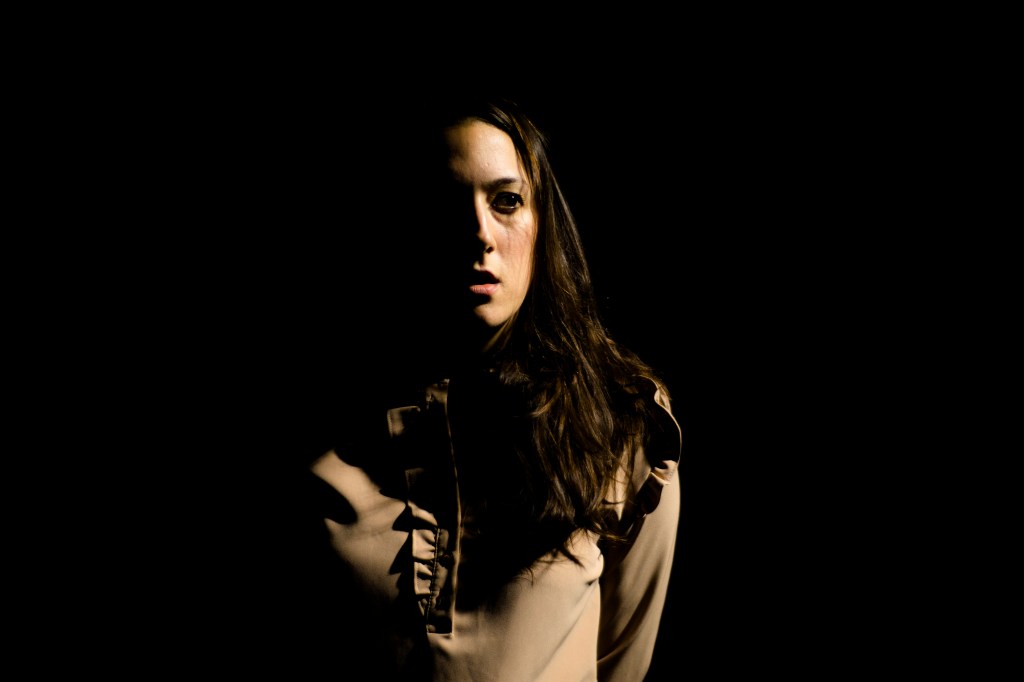
Theatre artists cast a spell every time they put on a show. The city of Edinburgh in August will be so charged with magic that the cobblestones of the royal mile will vibrate and crack. It is my Woolfish profile that you are looking at, but it will be her spirit in the black box theatre. Do not fret; she is a soft ghost, a little biting, but not unkind.
In the biography, Hermione Lee lists some of the labels that define Virginia Woolf. She was a “revered Modernist, novelist, essayist, playwright, comedienne of manners, snob, Marxist feminist, lesbian heroine, neurotic highbrow aesthete.” I would add: a muse, a language enchanter, a wise woman. By some logic, a witch.
I still struggle to give an elevator pitch of Modern Witches, not because I do not believe in the work, but because the show is as amorphous as Virginia Woolf’s selves. It’s a vibe. You just have to be there.
Modern Witches is playing this summer at the Edinburgh Fringe Festival at Greenside Infirmary Street August 14-19 and 21-26, 7:35PM-8:25PM BST. Tickets at edfringe.com.
Katie Kopajtic is a New York-based writer, actor, filmmaker, and occasional victim of the Edinburgh Fringe bug. Twitter/Instagram: @katiekopajtic
 IVWS
IVWS 